How to Hire a Web Design Agency Remotely
A practical guide to hiring a web design agency remotely, what to look for, what it costs across regions, red flags to avoid & what can be the smartest choice.
Anushka Gupta
7/10/202611 min read
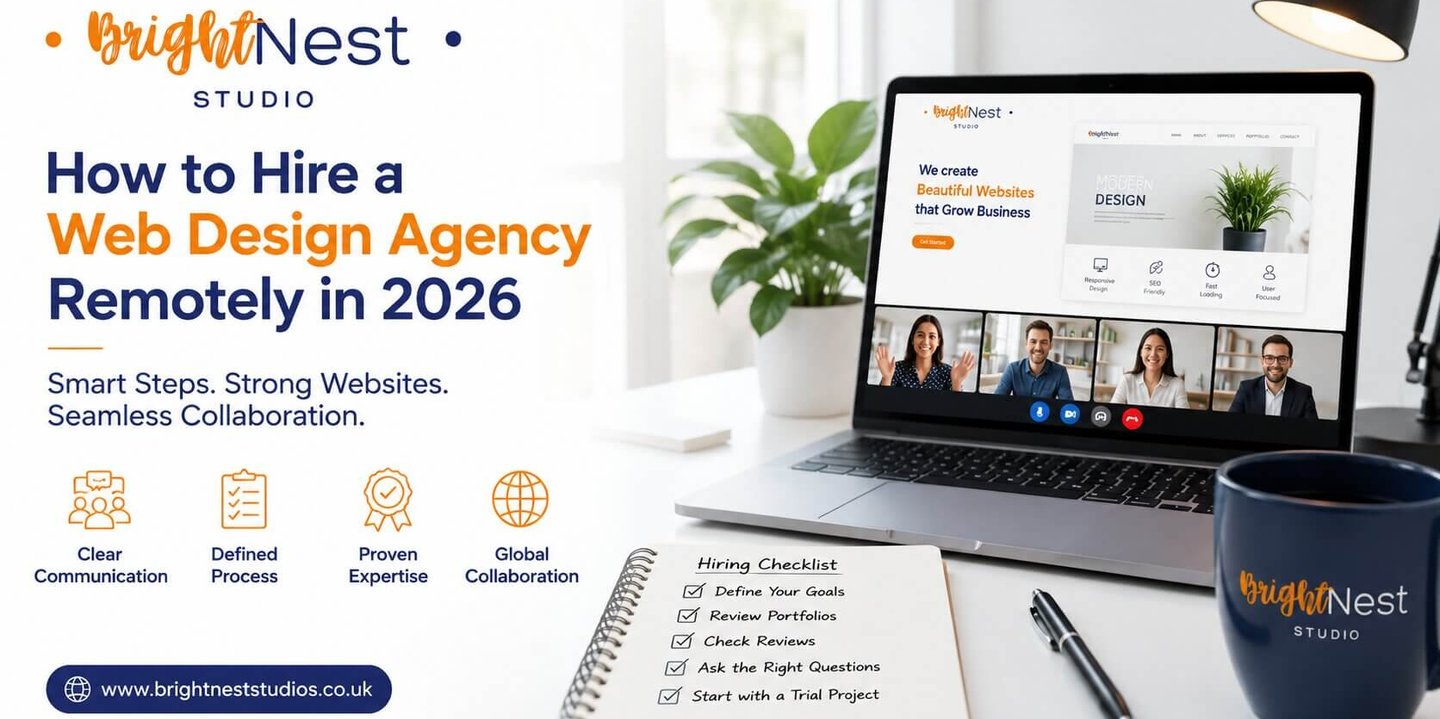
How to Hire a Web Design Agency Remotely: A Practical Guide
Office visits, in person pitches and a designer sitting across the table from you, that used to be how you hired a web design agency. It isn't anymore. Today, some of the best web design agencies work entirely remotely, and so do the businesses that hire them. Whether you're a start up in Austin, a retailer in Berlin, a growing brand in Warsaw, a boutique in Madrid, or an ambitious small business in Lahore or Mumbai, the agency doing your best work might be a thousand miles away and that's now a genuine advantage, not a compromise.
But hiring a web design agency remotely does come with real questions. How do you vet a team you'll never meet in person? How do you avoid overpaying, missing deadlines, or ending up with a generic template dressed up as "custom design"? How do you know the finished site will actually convert visitors into customers, rather than just look nice? This guide walks through exactly how to do it right, from the first discovery call to the moment your new site goes live, and everything in between.
We've written this for business owners and marketing leads across very different markets, because the fundamentals of a good remote hiring process don't change much whether you're based in Chicago, Cologne, Barcelona, Krakow, Karachi, or Delhi. What changes is pricing, time zone logistics, and a few practical considerations we'll cover market by market later in this guide.
Why Remote Web Design Hiring Has Become the Norm
The shift toward remote-first hiring isn't just a post-pandemic habit that stuck around, it reflects how differently businesses now think about talent and budget. Companies no longer default to the agency down the street. They look for the best combination of design quality, technical skill, and value, wherever that combination happens to sit on the map.
This is especially true for businesses in the USA, Germany, Spain, and Poland exploring options outside their home market, and for businesses in India and Pakistan looking for agencies with strong international design standards and English-first communication. A remote hiring model opens up all of these combinations at once, you're no longer limited to whoever happens to have an office nearby.
There's also a quieter shift happening: the tools that make remote collaboration feel effortless have matured enormously. Five years ago, handing over a design project to a team you'd never met in person felt risky. Today, with shared design files, live staging links, and async video walkthroughs, you can often see your website taking shape in more detail and more frequently than you ever could sitting in a boardroom waiting for the next big reveal.
For growing businesses, this matters for one more reason: budget flexibility. A remote-first agency isn't paying for a city-centre office lease that gets folded into your invoice. That overhead saving is one of the quiet reasons remote agencies can often deliver better value without cutting corners on quality.
What a Remote Web Design Agency Should Actually Offer
Before you get to pricing or contracts, use this checklist to separate a genuine remote-first agency from a freelancer working out of a spare bedroom (not that there's anything wrong with freelancers - you just need to know which one you're hiring, and budget your expectations accordingly).
A structured discovery process
A proper agency starts by understanding your business, your customers and what the website actually needs to achieve - leads, sales, bookings, credibility, before a single design decision gets made. This usually takes the form of a discovery call or short questionnaire covering your goals, your competitors, your existing brand assets, and what's frustrating you about your current site, if you have one.
Skip this step, or work with an agency that skips it, and you risk ending up with a website that looks good in isolation but doesn't actually solve the problem you hired them to solve.
A real portfolio, not just pretty screenshots
Ask to see live sites they've built, not just polished mock ups. A live site tells you how their work actually performs once real users, real content, and real devices get involved, mock ups can hide a multitude of sins, from slow load times to layouts that fall apart on an actual phone.
Where possible, look at a portfolio site on your own phone before you commit to anything. It takes thirty seconds and tells you more than any case study write-up.
Clear communication tools and cadence
Good remote agencies are precise about this upfront: which platform you'll use (Slack, email, WhatsApp, project boards like Trello or Notion), how often you'll get updates, and who your actual point of contact is. Vague answers here - "we'll just email as needed", are usually a sign the agency hasn't thought seriously about remote client management.
Mobile-first, conversion-focused design
In 2026, this isn't optional. Your site needs to work as well on a phone in São Paulo as it does on a laptop in Manchester. More than half of all web traffic worldwide now happens on mobile devices, and for many service businesses that figure is considerably higher. An agency that treats mobile as an afterthought — designing for desktop first and "squeezing it down" for phones, will hand you a site that quietly loses customers.
SEO built in from day one
Not bolted on afterward. A beautifully designed site that Google can't find isn't doing its job. This means clean URL structures, proper heading hierarchy, fast load times, and basic on-page optimisation baked into the build itself, not treated as a separate add-on service you have to buy later.
Transparent pricing and scope
In writing, before work begins. A trustworthy agency will tell you exactly what's included — number of pages, rounds of revisions, whether copywriting and photography are covered, and what counts as an "extra", rather than leaving it to be discovered mid-project.
The Remote Hiring Process, Step by Step
If you've never hired an agency you won't meet in person, here's roughly what the journey looks like from first contact to launch day.
1. Initial enquiry and discovery call
You reach out, usually through a contact form or a short call booking. A good agency will ask questions before pitching anything about your business, your customers, and what success looks like for the project.
2. Proposal and scope document
You should receive a clear, written proposal: what's being built, the timeline, the cost, and what happens if scope changes along the way. This is the document to read carefully, and to ask questions about before you sign anything.
3. Kick-off and content gathering
Once you're onboard, the agency will usually request your existing brand assets (logo, colours, photography), and begin gathering or drafting the copy for your site, depending on what's included in your package.
4. Design phase
You'll typically see wireframes or a homepage design concept first, with feedback rounds built in. This is usually done through a shared tool like Figma, so you can comment directly on specific elements rather than trying to describe changes over email.
5. Development and build
Once designs are approved, the site gets built out, usually on a private staging link you can view and test before it goes live. This is your chance to click through every page on both desktop and mobile.
6. Review and revisions
You'll have a set number of revision rounds (check this is clearly defined in your proposal) to request changes before launch.
7. Launch and handover
The site goes live, and you should receive login access, documentation, and clarity on who owns what, more on this below.
8. Post-launch support
A good remote agency doesn't disappear the day your site goes live. Ask what support, updates, or maintenance is included in the weeks and months afterward.
Tools That Make Remote Web Design Actually Work
Part of what makes remote hiring low-risk today is the maturity of the tools involved. You don't need to learn all of these yourself, but it's worth knowing what a professional remote agency should be comfortable using:
● Figma or similar — for shared, commentable design files, so you can see and react to designs in real time rather than waiting for a big reveal
● Slack, WhatsApp, or email threads — for day-to-day communication, with a clear agreed cadence
● Notion, Trello, or Asana — for shared project timelines and task tracking, so you always know what stage the project is at
● Loom or similar screen-recording tools — for async video walkthroughs of design decisions or how to use your new site, which removes a lot of back-and-forth
● A private staging link — so you can test the actual, functioning site before it ever goes public
Questions to Ask Before You Hire
A short list of direct questions will tell you more than any sales pitch:
● What does your process look like from kick-off to launch, week by week?
● Can I speak to a current or recent client?
● What happens if I need changes after the site goes live — is that included, or extra?
● How do you handle time zone differences during the project?
● Who owns the code, the design files, and the content once the project is finished?
● What platform or CMS will the site be built on, and can I make basic edits myself afterward?
● What's your policy if the project runs over the agreed timeline?
● Do you handle hosting and domain management, or is that on me?
If an agency is vague about any of these, that's worth noting. The clarity of the answer usually says more than the answer itself.
What Does It Actually Cost?
Web design and development pricing varies enormously depending on where an agency is based, and understanding that range helps you budget realistically and spot a quote that's either wildly overpriced or too good to be true.
As a rough guide in 2026: agencies based in North America and Western Europe (including Germany and much of the UK/US market) tend to sit at the premium end, reflecting higher local costs and, often, more senior consulting and strategy work built into the price. Agencies in Eastern Europe - Poland especially, have built a strong reputation for combining solid technical depth with more accessible pricing than Western Europe or the US, which is part of why so many US and German businesses now look there for remote partners. Agencies in South Asia, including India and Pakistan, typically offer the most competitive rates of all, and for straightforward marketing sites or landing pages, that value can be excellent, provided you vet portfolio quality carefully, since the price range in that region is wide.
Simple marketing or brochure websites
A simple, professionally designed small-business website (5–10 pages, custom design, mobile-optimised, basic SEO foundation) typically falls in the low-to-mid thousands in GBP or USD, regardless of region, once you're working with an established agency rather than a template marketplace.
E-commerce and booking-enabled sites
Sites that need to handle payments, product catalogues, or booking systems cost more everywhere, because the underlying build is more complex and the testing requirements are higher. Expect this to run into the higher end of the small-business bracket, and sometimes well beyond it depending on how many products or integrations are involved.
Ongoing maintenance and hosting
Don't forget to budget for what happens after launch. Hosting, security updates, and content changes are ongoing costs, whether you handle them yourself or pay your agency a retainer to manage them. This is often the most overlooked line item in a web design budget.
The number that matters most
More important than any of these ranges is total cost of ownership. A cheaper site that needs a full rebuild in eighteen months isn't actually the cheaper option and a website that was never quite optimised for search in the first place can cost you far more in missed customers than it ever saved on the invoice.
Red Flags to Watch For When Hiring Remotely
A handful of warning signs tend to predict a difficult project long before anything goes wrong:
● No live examples of previous work, only mock-ups or "concepts" — this often means the portfolio is aspirational rather than proven
● Pricing that's dramatically below every other quote you've received, with no explanation of what's excluded — someone, somewhere, is cutting a corner
● No clarity on who you'll actually be working with day-to-day — a sales call with one person and a handover to an anonymous "team" afterward is a common source of frustration
● Reluctance to put scope, timeline, and revisions in writing — verbal promises are hard to enforce once a project is underway
● Communication that's slow or vague even during the sales process — it rarely improves once you've signed and the pressure to win your business has passed
● No mention of mobile responsiveness or SEO unless you specifically ask — these should be default parts of any 2026 web design conversation, not premium extras
Why a UK-Based Agency Is a Smart Middle Ground for International Clients
Here's the angle worth considering if you're comparing options across the USA, Germany, Spain, Poland, India, and Pakistan: a UK-based team sits in a genuinely useful middle position.
Cost
Relative to US and German agency rates, a UK agency, especially one based outside London, like Nottingham — is typically more accessible, without the wider quality variance you sometimes find at the very low end of the price range. You're not paying central-London or Silicon Valley overhead, but you are getting a team operating in a competitive, quality-conscious market.
Time zone overlap
UK hours overlap well with Europe (Germany, Poland, Spain) for real-time collaboration during the working day, and comfortably with the US East Coast for morning or evening calls. For businesses in India and Pakistan, the overlap sits neatly in the UK afternoon and your evening, workable for weekly check-ins even if it's not a full working-day overlap.
Native English communication
This removes a layer of friction that can slow down projects when instructions and feedback need to travel through translation, or when nuance gets lost between a brief and a build. For businesses in Germany, Spain, and Poland working in a second language, this alone can meaningfully speed up a project.
GDPR-native thinking
This matters directly to businesses in Germany, Poland, and Spain, and increasingly to US businesses serving European customers. A UK agency builds with data protection and cookie compliance as a baseline assumption, not a bolt-on afterthought.
Design standards shaped by a competitive market
UK and European clients expect strategy and conversion thinking, not just visual polish — which tends to produce agencies that think commercially about design, rather than treating a website as a purely aesthetic exercise.
A note for US, Indian and European businesses specifically
If you're in the USA, a UK agency often gives you senior-level design thinking at a lower cost base than a comparable domestic agency, with a genuinely workable overlap window. If you're in India or Pakistan and considering a UK partner rather than a domestic or Gulf-based one, the appeal is usually less about cost and more about positioning, a UK-based portfolio and case studies can carry real weight if you're marketing to Western customers yourself.
That combination - accessible pricing, strong communication, and design built around real business outcomes, is exactly what BrightNest Studio offers international clients, whether you're based in Nottingham or Nebraska, Berlin or Bangalore, Warsaw or Lahore.
Frequently Asked Questions
Is it safe to hire a web design agency I've never met in person?
Yes, provided you vet them properly. A live portfolio, clear references, and a written scope of work matter far more than physical proximity. Thousands of successful projects now run entirely through video calls, shared documents and staging links.
How long does a typical remote web design project take?
A straightforward small-business site usually takes four to eight weeks from kickoff to launch. More complex projects with custom features or e-commerce can take longer, particularly if third-party integrations or custom functionality are involved.
Do I need to be in the same time zone as my agency?
No. A well-organised remote agency builds in overlap hours for calls and reviews, and uses async tools (shared boards, recorded walkthroughs) to keep things moving outside those hours.
What's the difference between a freelancer and an agency for this kind of work?
A freelancer is often more affordable but relies entirely on one person's availability and skill set. An agency brings a small team - design, development, SEO, project management - so the work continues even if one person is unavailable, and the final result tends to be more rounded.
Who owns the website once it's finished?
This should be agreed in writing before the project starts. Reputable agencies transfer full ownership of the code, content, and design files to you on final payment - make sure this is explicit in your contract, not assumed.
Can I make changes to my own website after launch?
This depends on the platform it's built on. Ask specifically whether you'll have a content management system you can log into yourself, and whether basic training or documentation is included as part of the handover.
What if I'm not happy with the first design concept?
A clear proposal should specify how many rounds of design revisions are included before extra costs apply. This is exactly why getting scope in writing upfront matters — it protects both sides.
Why BrightNest Studio Is the Right Partner
Makes the direct case: discovery-first process, accessible pricing vs. US/Western Europe without the quality gaps of the cheapest options, direct access to the actual team, and a mobile-first, SEO-ready build. It closes the loop naturally, everything the guide argued for is now positioned as exactly what BrightNest delivers.
Tel: +44 7769 004216
Email: anushka@brightneststudios.co.uk
Website: https://brightneststudios.co.uk/
BrightNest Studio - UK
Creative by Nature. Strategic by Design.
© 2026. All rights reserved
INDIA Phone: +91 7337505184